



In Canada, spouses, children, beneficiaries, and others who would inherit if a will were invalid may have the right to contest it. The grounds for a challenge matter, as claims may involve unfair disinheritance, undue influence, fraud, lack of testamentary capacity, or improper execution. If you believe you have a valid claim, speak with an estate lawyer promptly because strict deadlines can apply.
At Onyx Law Group, we specialize in estate litigation, helping individuals and families in British Columbia tackle contested wills with confidence. Candace Cho, KC, leads that practice from the firm’s downtown Vancouver office and spends her entire practice on estate and trust litigation. Our legal team has decades of experience handling high-stakes estate disputes, including cases involving undue influence, lack of capacity, and unjust disinheritance under WESA. If you’re not sure whether you have standing to challenge a will, contact us today for your free consultation!
In this blog post, we’ll have a look at legal grounds for contesting a will and who can contest a will in Canada.
Who Can Contest a Will in Canada?

Estate disputes can affect a significant number of Canadian families each year. Data from Statistics Canada shows that the agency recorded 326,779 deaths in Canada in 2024, meaning hundreds of thousands of estates may need to be administered, distributed, or resolved each year.
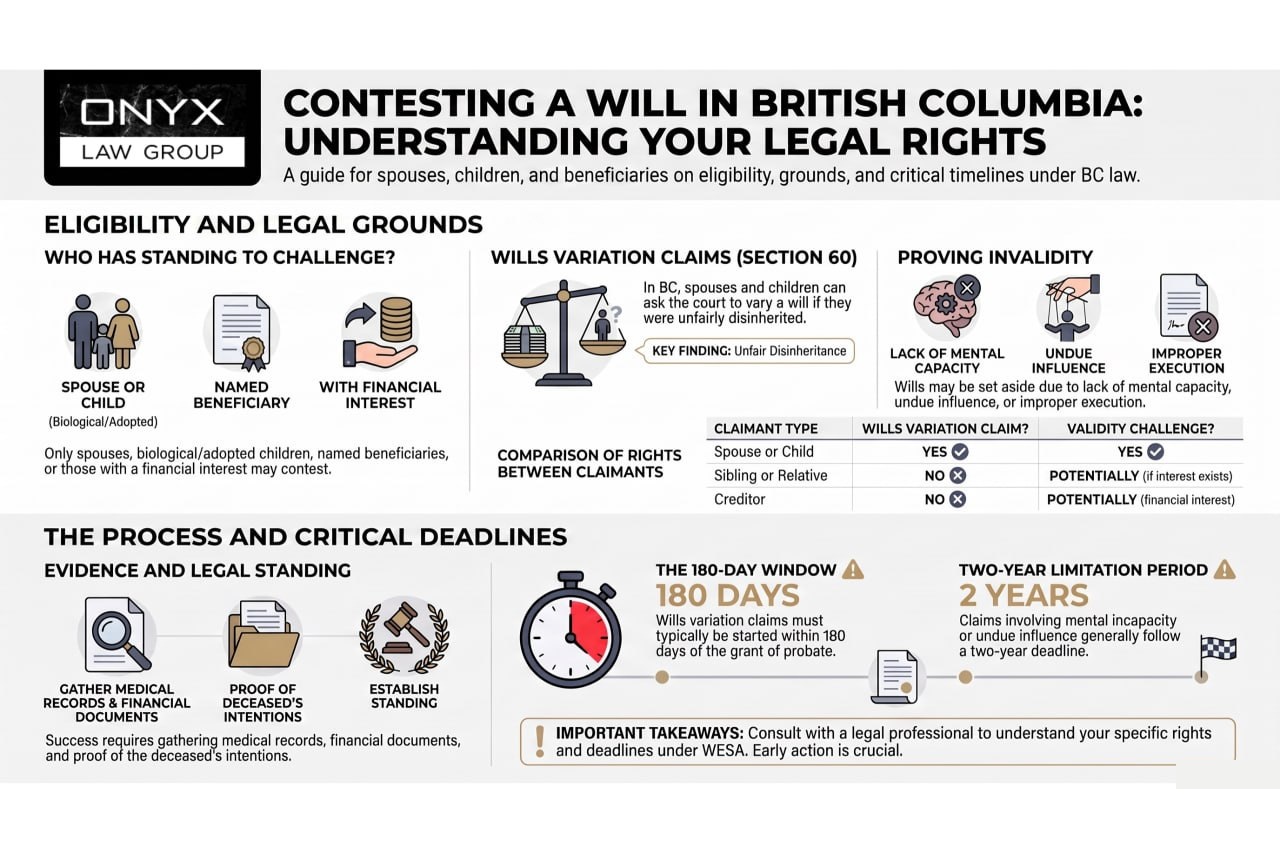
According to Canadian law, those who can contest a will include the spouse, children (biological and adopted), beneficiaries named in the will, and beneficiaries named in a previous will. In the same vein, individuals who would inherit under intestacy laws if the will were deemed invalid can also contest.
Under British Columbia Law, “spouse” means a legally married spouse and a common-law spouse. That means a spouse is not only someone who was married to the deceased or testator. It also includes those who lived with the deceased for at least two years and were in a marriage-like relationship. Also, “child” means a biological child or adopted child of the deceased but does not include a deceased person’s stepchild. In addition, during court proceedings, the one contesting a will is called the plaintiff.
There are certain grounds on which you can contest a will. But before we cover that, let’s look at what wills variation claim means and the provision offered to you by law to contest a will that is deemed unfair.
What is a Wills Variation Claim?
Section 60 of the WESA, allows a spouse or a child of the deceased to ask the court to vary the terms of the deceased’s will on the basis that they were unjustly disinherited or didn’t receive adequate provision in all the circumstances. The court will consider whether the inheritance in the will meets the legal and/or moral obligations to the claimant and weigh the competing moral claims of other beneficiaries before determining whether the will should be varied.
If the wills variation claim succeeds, the court will impose an alternative distribution of the estate assets that meets the deceased’s legal obligation and/or moral obligation to claimants. But here’s the catch: only the spouse or child of the will-maker can bring a wills variation claim.
BC estate law states that a person must provide for their surviving spouse and children in a way that is “adequate, just, or equitable.” There is no general requirement for a person to provide for friends, other types of relatives, charity, etc.
Even adult children of the deceased can apply to vary their parent’s will and seek a different distribution of their parent’s estate. Generally speaking, if the estate has sufficient assets, and in the absence of circumstances negating the existence of a moral obligation, some provision for adult children should be made.
However, the moral obligation to financially independent adult children does not typically outweigh the moral obligation to provide proper maintenance to a surviving spouse or dependent children, minor children, or children not able to be financially dependent for other reasons such as a disability. It will depend on several factors, including financial circumstances, family circumstances, and what a reasonable will-maker would be expected to do in a similar situation.
Other Types of Challenges With Contesting a Will
Only the spouse or child of the will-maker can challenge an otherwise valid will that leaves an unfair or inadequate inheritance. What if you aren’t the deceased’s spouse or child, or what if your concern arises from one of the other grounds for challenging a will?
You can challenge the validity of a will on other specific grounds (such as a lack of testamentary capacity, suspicion that the will-maker was unduly influenced, concern that the will was not executed by two independent witnesses, etc.) even if you’re not a spouse, child, or immediate family member of the deceased. However, you must have an interest in the estate to do so.
So, you would be eligible to contest a will if you have an interest in the estate as a beneficiary named in the most recent will, as a beneficiary named in previous wills, or as an heir who would inherit under the rules of intestacy if the will is deemed invalid. People with a financial interest in the estate may also have legal standing (such as a person to whom the estate owes a debt).
If your will challenge is successful, the will or parts of the will are deemed invalid by the court. The will-maker’s next most recent valid will is used. It will govern how the estate is distributed. If there is no prior will, the rules of intestacy determine how the estate must be distributed. In other words, the deceased’s estate will be divided according to the rules that apply when a person dies without a legally valid will (“died intestate”).
Who Can Contest a Will? Comparing Your Legal Options
Not everyone has the same right to challenge a will in Canada. In British Columbia, the type of relationship you had with the deceased can affect both your standing and the type of claim you may bring. The table below highlights the key differences.
| Who You Are | Can You Contest the Will? | Possible Legal Basis | Key Consideration |
|---|---|---|---|
Spouse | Yes | Wills variation, lack of capacity, undue influence, fraud, improper execution | A spouse may seek a variation if the will does not provide adequately, justly, and equitably. |
Child | Yes | Wills variation, lack of capacity, undue influence, fraud, improper execution | Adult children may also bring a wills variation claim in BC. |
Beneficiary in the current will | Potentially | Lack of capacity, undue influence, fraud, improper execution, or other validity issues | You generally need an interest in the estate to challenge the will. |
Beneficiary in a previous will | Potentially | Will validity issues or other grounds affecting the current will | An earlier will may become important if the current will is successfully challenged. |
Sibling or other relative | Not simply because you were left out | Lack of capacity, undue influence, fraud, improper execution, or another recognized ground | Being a family member does not automatically give you the right to a wills variation claim. |
Creditor or person with a financial interest | Potentially | Grounds affecting the validity or administration of the estate | The nature of your financial interest matters. |
Stepchild | Not automatically | Other recognized legal grounds may apply if you have an interest in the estate | A stepchild is not treated as a “child” for a BC wills variation claim under WESA. |
On What Grounds Can You Contest a Will?

“Being left out of a will does not always mean you have no legal options, but you need to understand what type of claim you may have,” says Kevin Campbell, an estates and trust lawyer at Onyx Law Group. There are specific grounds or reasons for a will to be contested, and they are provided by the Wills, Estate, and Succession Act. So, if a will violates the provisions of these laws, you can contest it. The grounds for contesting a will include:
Lack of Testamentary Capacity
You may be able to ask the Court to set aside a will if it was signed by a will-maker who didn’t have the mental ability to make a will. Medical evidence is relevant here, but the test for testamentary capacity is legal, not medical. Questions about testamentary capacity can become especially important as Canada’s population ages. In the 2021 Census, about 7 million Canadians, or 19% of the population, were aged 65 or older.
You may be able to ask the court to set aside a will if the will-maker did not have the mental capacity to make it. Medical evidence can help, but testamentary capacity is ultimately a legal test, not a medical one. This issue is becoming increasingly relevant as Canada’s population ages. Statistics Canadareports that 7.02 million Canadians, or 19% of the population, were aged 65 or older in the 2021 Census, making questions about capacity more relevant in some estate disputes.
Undue Influence or Coercion
You may be able to ask the Court to set aside a will that was made because someone exerted undue influence on the will-maker. For example, threats or pressure from a relative or caretaker to the degree that the will does not reflect the will-maker’s true intentions.
Improper Execution of the Will
For a will to be valid, it must meet the formal requirements set out in s. 37 of the Wills, Estates, and Succession Act. It must be written and signed by the will-maker in the presence of two witnesses who are independent and who also sign the will. You can ask the courts to invalidate a will if it was improperly executed.
Fraud or Forgery
You may be able to challenge a will that you believe was faked or forged. This is particularly common for handwritten wills. To prove the will is fraudulent, you’ll need a handwriting expert to support your case.
Ambiguity in the Will
A will can be contested if it is ambiguous or unclear (for example, the list of beneficiaries is not clearly defined). The court can interpret the will to resolve the ambiguity.
Unfairness in the Will
In certain circumstances, you can ask the court to vary a will in your favour if you were treated unfairly or did not receive a fair share of the estate. This is known as a “wills variation claim,” and it is provided for in s. 60 of the Wills, Estates and Succession Act, S.B.C. 2009, c. 13 (“WESA”). To have a successful challenge, you must have valid legal standing, you must be able to provide evidence to support your case, and you must also be eligible to contest the will.
How Easy Is It to Contest a Will in Canada?
Contesting a will in Canada isn’t easy, but it’s possible if you have valid grounds, a strong legal basis, and meet the eligibility requirements.The court won’t overturn a will just because someone feels it’s unfair, it must be legally invalid for specific reasons.
The process requires gathering evidence, filing legal documents, and potentially going to court. In British Columbia, for example, you must prove that the will-maker lacked mental capacity, was unduly influenced, or that the will had been improperly executed. Family law may also become relevant where the dispute involves a surviving spouse or other family rights. If you’re a spouse or child, you may also challenge the will under WESA if you were unfairly disinherited.
Each province has its own estate laws and deadlines, so timing is important. If you believe you have a valid claim, consulting an estate lawyer early is the best way to assess your chances of success.
How to Contest a Will in Canada

Contesting a will in Canada can be a complex and challenging process, but it is possible to win if you have a valid legal claim, proper standing, and can provide evidence to support your case. Here are the general steps to contest a will in British Columbia:
Step 1: Understand the Viable Grounds for Contesting the Will
In British Columbia, the grounds for contesting a will are limited to the reasons set out above (e.g., lack of capacity, undue influence, fraud or forgery, or non-compliance with formal requirements).
Step 2: Ensure You Have Standing to Bring That Legal Action
Having ‘standing’ means you have the legal right to challenge the will. In British Columbia, you must be either a spouse, a child (including legally adopted children), a beneficiary named in the will, or someone named in a previous will. In other words, without proper standing, the court will not hear your challenge, regardless of how strong your evidence may be.
Step 3: Gather Evidence
Gather all relevant documents and evidence, such as medical records, bank statements, and any other documents that may be relevant to your claim. For example, if you suspect undue influence, try to find evidence of the relationship between the deceased person and the other party who may have influenced the deceased.
Step 4: Consult With a Lawyer
According to Candace Cho, principal lawyer at Onyx Law Group, “Will disputes can be deeply personal, which is why having a clear understanding of your legal rights can make the process less overwhelming.” It is recommended that you consult with an estate lawyer who is experienced in contesting wills in British Columbia.
Step 5: File a Wills Variation Claim or Other Claim Contesting the Will
Once you have a strong case, you will need to file a wills variation claim or other claim contesting the will with the Supreme Court of British Columbia. This starts the legal process and provides the estate trustee (executor of the estate) with notice that the will is being contested.
Step 6: Attend Court
You will need to attend court to present your case. It is important that you don’t fail to provide evidence to support your claim and cross-examine any witnesses called by the executor of the estate. Remember that you are better off with your lawyer compared to when you are alone. So, let them do the cross-examination, as they are more experienced than you are and can ask the right questions.
Step 7: Be Prepared for the Outcome
Even if you have a strong case, there is no guarantee that you will win. The court will consider all the evidence presented and make a decision based on the law and the facts of the case.
Can a Sibling Contest a Will if Left Out?
Yes, but only under specific circumstances. Unlike spouses and children, siblings don’t have an automatic right to contest a will just because they were left out. However, they can challenge it on legal grounds such as lack of testamentary capacity, undue influence, fraud, or improper execution. On this matter, Jesse Patrao, an estate and trust lawyer at Onyx Law Group, said, “A sibling who is left out of a will does not automatically have the same rights as a spouse or child under BC law.”
If the will is declared invalid, an earlier version may take effect, or the estate could be distributed under intestacy laws that apply when dealing with invalid wills. If you suspect something is wrong, gathering evidence and seeking legal advice quickly is key.
Can You Leave a Child Out of Your Will in Canada?
In most provinces, yes, you can disinherit an adult child if you choose. However, British Columbia is the major exception. Under section 60 of WESA, children, including adult children, can challenge a will if they were unfairly left out or received inadequate support. The court will weigh whether the will-maker had a moral and legal obligation to provide for them.
In other provinces, disinheriting a child is generally allowed, but it can still be challenged under certain conditions. In such cases, the circumstances and evidence supporting the challenge will determine whether a legal claim can proceed. One condition is if the child was financially dependent on the deceased.
Another reason is if there’s evidence of undue influence or fraud, and finally if the will’s language is ambiguous. To minimize disputes, it’s wise to clearly document your reasons for disinheriting a child and consult an estate lawyer when drafting your will.
How Long Do You Have to Contest a Will in Canada?

There are strict deadlines that must be met if you want to vary or challenge a will. The deadline depends on the type of claim you are bringing. For instance, a two-year limitation period applies if you are contesting a will on the grounds of mental incapacity or undue influence.
The limitation period is different if you’re the spouse or child of the will-maker applying to vary the will pursuant to s. 60 of WESA because you weren’t provided with an adequate, just, or equitable inheritance. In that situation, you must start your legal action within 180 days of the date the Canadian Supreme Court issues a grant of probate.
In Canada, most challenges happen after the will has entered probate. That being said, you can contest a will either before or after the estate trustee has started the probate process. If you think you want to contest a will in Canada, the best course of action is to seek legal advice from an estate lawyer as soon as possible to ensure deadlines aren’t missed.
Need Help Contesting a Will in Canada?
In Canada, only certain individuals, such as spouses, children, beneficiaries, and those with a financial interest in the estate, can contest a will, and they must have valid legal grounds to do so. Common reasons for challenging a will include lack of testamentary capacity, undue influence, fraud, improper execution, or unfair distribution under British Columbia’s Wills, Estates, and Succession Act (WESA).
Contesting wills can be a complex and emotionally draining process. The stress of legal action is compounded when the issues are deeply personal and involve close family members. It’s extremely important to get legal advice before proceeding.
Cut out of a parent’s will and wondering if you can do anything about it? At Onyx Law Group, our estate planning and estate litigation lawyers in BC seek equitable solutions for you, and we stand by you through the process. Candace Cho, KC, has built her entire practice on these cases, and Onyx acted in Grewal v. Litt, one of BC’s leading wills variation decisions. Contact us for a free 30-minutes consultation and find out whether you have a claim.
Frequently Asked Questions
Contesting a will in Canada involves challenging its validity or seeking changes to the will’s provisions. The steps involved and time limits vary depending on provincial and territorial laws.
How Long Does It Take to Contest a Will in Canada?
There is no standard timeframe because cases vary based on the claim, parties involved, and court process. The person contesting the will must also consider applicable time limits, as a two-year limitation period applies to some claims but not all.
How Much Does It Cost to Contest a Will in Canada?
There is no fixed amount for legal fees, which vary depending on the claim, parties involved, and whether the case goes to trial. Proper documentation and early legal advice may help control costs and resolve disputes sooner.
On What Grounds Can You Contest a Will in Canada?
Common grounds include concerns about whether the person making the will was mentally capable and of sound mind, undue influence, fraud, or forgery. Depending on the jurisdiction, other aspects may include holographic wills, verbal promises, or whether the will was properly witnessed.
Can a Power of Attorney Override a Will in Canada?
Generally, a power of attorney cannot override or rewrite a person’s last will. The rules vary under provincial and territorial laws, but an attorney generally cannot use a power of attorney to make or change a will for another person.
Disclaimer: The information on this page is general legal information about British Columbia law, not legal advice for any specific situation. Reading this page does not create a solicitor-client relationship. BC law changes, and the procedure that applies to a specific situation depends on facts not covered here. For advice on your situation, consult a qualified British Columbia estate lawyer directly. Past results, illustrative scenarios, and reference to typical fact patterns do not guarantee similar outcomes in any specific case.