



In a BC divorce, you’re generally entitled to an equal share of family property and debt built up during the marriage, plus spousal support if you qualify based on need and your ex’s ability to pay. Knowing these rights matters because without them, you risk losing assets, support, or getting stuck with more than your fair share of debt.
Judith A. Janzen has practised family law in British Columbia since 2000. She leads the family law practice at Onyx Law Group and holds the Canadian Bar Association’s BC Branch President’s Medal. Our team argued Zhang v. Chen, a 2023 BC Supreme Court case with up to $90 million in assets that produced one of the province’s highest interim support awards. If you’re separating and need a straightforward answer, contact us today for a free initial consultation.
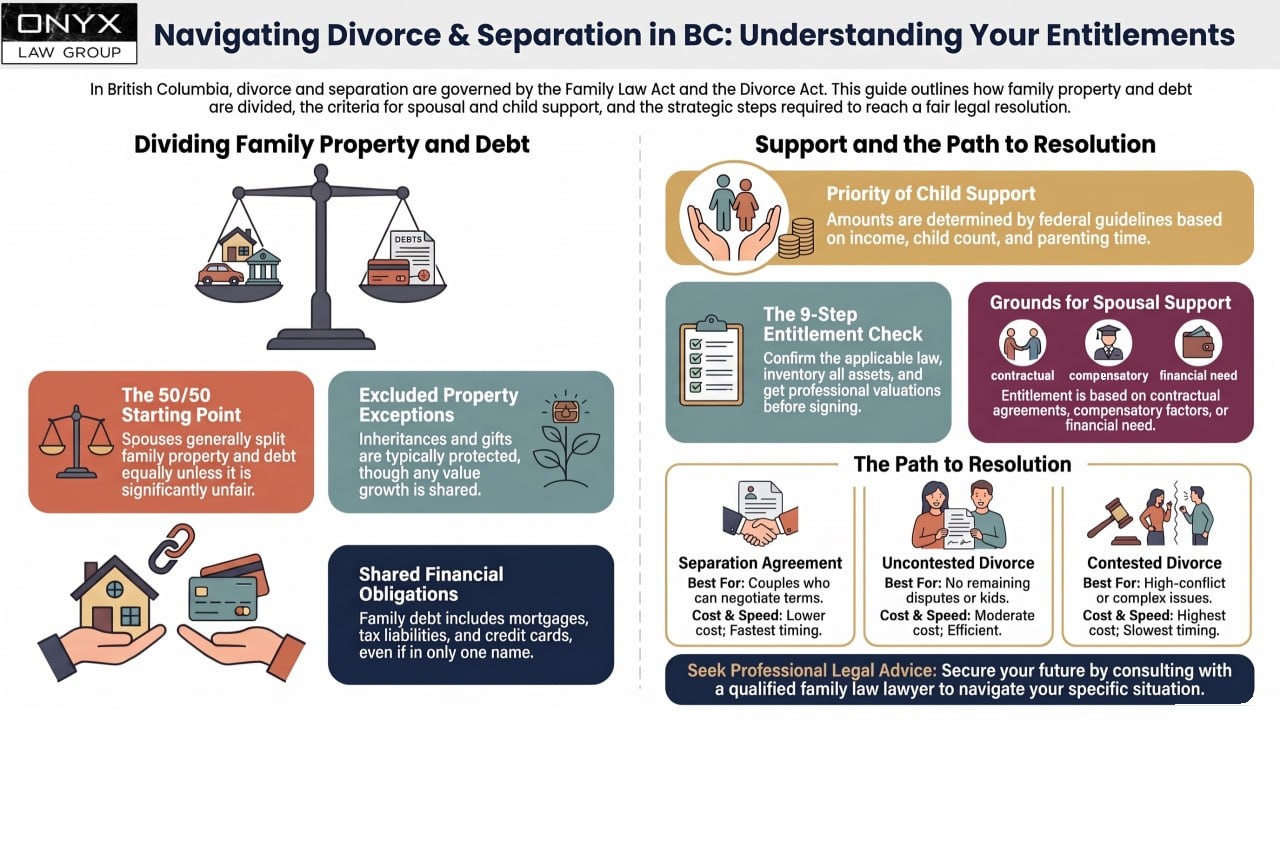
This blog breaks down what you’re entitled to in a BC divorce, covering property division, spousal support, and debt, so you know your rights before you negotiate anything.
Overview of Divorce Law in British Columbia

Divorce and family law in BC can feel like a maze, mostly because two different laws are at play depending on your situation. Canada’s Divorce Act only applies if you’re legally married, and it covers divorce itself, child support, spousal support, and parenting arrangements (what people used to call custody and access). Most divorces proceed on the basis of a year’s separation, though the Act still allows for fault-based grounds, such as when a spouse has committed adultery, as a path to divorce.
BC’s Family Law Act covers a broader range of situations. It applies to married spouses, but also to common-law spouses (couples who’ve lived together in a marriage-like relationship for at least two years, or less if they share a child), and to unmarried couples with children. Under the Family Law Act, you’re looking at property and debt division, guardianship, parenting time, contact with a child, plus child and spousal support too.
Because these two laws overlap in some areas and diverge in others, figuring out which one applies to you, or whether you need both, isn’t always straightforward. A family lawyer can walk you through which route makes the most sense for your specific circumstances and help you use whichever law works in your favor.
What Is the Process of Divorce in BC?
Divorce is the only way to legally end a marriage, but there are several approaches to resolving family law issues so that you’re in a position to apply for a divorce order. Note that you don’t need a divorce order to end a common-law marriage.
For example, if you are legally married, you can apply to the BC Provincial Court using the Family Law Act to resolve support issues and issues pertaining to your children and then apply to the Supreme Court of BC for an uncontested divorce under the Divorce Act (also called a desk order divorce). These early steps often shape how the rest of your divorce proceedings unfold.
Another approach is for you and your spouse to negotiate a separation agreement and later apply for a divorce order. A third approach is to bring a contested divorce application, asking a judge of the Supreme Court to decide all outstanding family law issues, issue a court order settling them, and then grant you a divorce.
How Are Assets and Debts Divided in a BC Divorce?
“If I divorce my husband, what am I entitled to?” and “What is a wife entitled to in a divorce?” are two of the most common questions family lawyers hear. The rules we’ve covered so far set out the default framework for property division in BC divorces, but spouses always have the option to agree to something different.
If you’re a BC resident, the Family Law Act governs how spouses divide property and assets on separation, regardless of whether you’re legally married or in a common-law relationship. Under this law, spouses split family property and family debt 50/50 unless doing so would be significantly unfair. Excluded property works differently. It’s presumed to stay with the spouse who owns it rather than being divided.
That said, a 50/50 split isn’t mandatory if both spouses see things differently. You and your spouse can agree to divide family property and family debt unequally, based on whatever you both consider fair. This can happen through a separation agreement drawn up after the relationship ends, or it might already be addressed in a cohabitation agreement or marriage contract you signed earlier in the relationship.
Spouses can agree to shift the outcome away from a 50/50 split. Courts can also step in and order an unequal division, though only when an equal split would be significantly unfair, a fairly high bar that isn’t met just because one spouse feels shortchanged. Judges look at factors like how long the relationship lasted, how any debt was acquired, and whether one spouse’s conduct after separation ran up debt or hurt the value of family property.
What Are You Entitled to in a Divorce in BC?

In BC, the starting point for dividing things after a split is simple on paper: spouses split family property and family debt equally. Of course, the real question is what actually counts as family property or family debt in the first place, and that’s where things get more detailed.
Family property covers pretty much anything you or your spouse acquired during your relationship, whether it’s in one name or both. This includes assets either of you owned at the time you separated, plus anything either spouse has a beneficial interest in at that point.
Think family homes, cottages, or investment properties; RRSPs, RRIFs, TFSAs, bank accounts, investments, insurance policies, pensions, businesses, and certain property held in trust. Even growth in the value of excluded property falls into this category, which is a detail people often miss.
Family debt works on a similar logic. It covers financial obligations either spouse took on during the relationship and even debts incurred after separation if that debt went toward maintaining family property. Mortgages, loans, lines of credit, credit cards, tax liabilities, and vehicle financing are the most common types of family debt. One thing that catches people off guard is that BC law requires spouses to split family debt equally, even if only one spouse’s name is actually on it.
Excluded property is the exception to all this. It’s property one spouse brought into the relationship rather than acquired during it, like inheritances, gifts from a third party, damage or settlement awards for injury or loss, insurance proceeds (outside of property insurance), and a spouse’s beneficial interest in a discretionary trust. This kind of property generally stays out of the equal division pot.
That said, excluded property isn’t automatically protected forever. Any increase in its value during the relationship is still subject to equal division. And if that property gets mixed in with family assets, say, an inheritance gets deposited into a joint account, or used to buy a home held jointly, it can lose its excluded status altogether. So keeping that property separate and traceable really matters if you want to keep the exclusion.
How to Determine What You’re Entitled to in a BC Divorce
Figuring out what you are entitled to in a BC divorce is not a single calculation. It depends on the law that applies to you, the property and debt involved, and whether support is on the table. The steps below walk through how to work this out in order.
Step 1: Confirm which law applies to you
Start by figuring out if you’re covered by the Divorce Act, the Family Law Act, or both. This changes everything downstream, from how property gets split to how support gets calculated, and married couples in particular may find both laws come into play at once.
Step 2: List every asset and debt from the relationship
Make a full inventory of what you and your spouse own and owe, including the date you separated. This becomes the foundation for dividing family property and family debt down the line.
Step 3: Sort out what counts as excluded property
Go through your list and pull out anything that might be excluded, like inheritances, gifts, or property you brought into the relationship. Keep records that trace where this property came from and how it’s been kept separate.
Step 4: Get a value on everything
Have your property and debt properly valued as of the separation date. This includes homes, pensions, investments, and any businesses, since guesswork here almost always causes disputes later.
Step 5: Work out entitlement to spousal support
Look at whether you or your spouse qualify for support based on contractual, compensatory, or needs based grounds. The length of the relationship and each person’s role during it both play a big part here.
Step 6: Calculate child support, if it applies
Use the Federal Child Support Guidelines to figure out the base amount, then factor in special or extraordinary expenses. Your parenting arrangement will shape who pays and how much.
Step 7: Think through the tax side of things
Some assets come with tax consequences attached, and spousal support is taxed differently than child support. Factor this in before you agree to anything, since a fair looking split on paper can look very different after tax.
Step 8: Decide how you’ll resolve things
Choose whether you’ll negotiate a separation agreement, apply through the courts, or pursue a contested divorce. If you need to stay in the family home while things get sorted, this is also the stage to raise exclusive occupancy as part of your family claim.
Step 9: Get legal advice before you finalize anything
Have a family lawyer review your numbers and any agreement before you sign. This is the step that protects you if something was missed or valued incorrectly earlier on.
Who Can Claim Spousal Support in BC?

Few issues in a separation cause as much stress and uncertainty as spousal support, whether you’re the one asking for it or the one being asked to pay. In BC, both married and common-law spouses can make a claim. For common-law couples, the relationship must have involved continued cohabitation like a marriage for at least two continuous years for support to be available.
Married spouses have a choice of legislation too. They can apply under BC’s Family Law Act or under Canada’s Divorce Act, while common-law spouses only have the option of applying under the Family Law Act.
Whether you were married or in a common-law relationship, the test for entitlement is the same. The spouse asking for support has to establish it on at least one of three recognized grounds: contractual (say, through a marriage agreement), compensatory, or non-compensatory, which is often called needs-based. A few factors shape how strong that claim is, including how long the relationship lasted, what role each spouse played during it, and whether there’s already an order, agreement, or arrangement dealing with support.
Once entitlement is established, the harder questions usually follow: how much financial support and for how long? This is where the Spousal Support Advisory Guidelines come in. They’re not law exactly, but they offer ranges based on common scenarios, which makes them a useful starting point for figuring out an appropriate amount and duration, taking each spouse’s financial situation into account. Unlike damage awards in a civil claim, spousal support isn’t meant to punish or compensate for wrongdoing. It’s meant to address fairness between the spouses.
Even with the Guidelines as a reference, calculating spousal support is one of the more challenging areas of family law, since so much depends on the specifics of your situation. Where parties agree on a number themselves, that arrangement is often easier to live with than one imposed by a court. It’s worth getting proper guidance rather than trying to land on a number alone.
Child Support Claims
Child support is one of the pillars of any separation, since it’s what keeps a child’s financial needs covered once parents live apart. It’s the money one parent pays the other to help with the everyday costs of raising a dependent child, typically monthly, and it’s meant to handle things like shelter, food, clothing, hygiene, and day-to-day extras. Straightforward as that sounds, actually landing on the right number can get complicated fast.
Beyond the base amount, parents also chip in for what are called special or extraordinary expenses, the costs that fall outside normal day-to-day living. Health care, dental work, tutoring, private school tuition, and certain extracurriculars are the usual examples. The general rule is that these are split between parents in proportion to their income, though they are free to agree to a different arrangement if that suits their situation better.
In BC, the amount of child support comes down to the paying parent’s income, the number of children involved, and the province they live in. Usually, that calculation follows the Federal Child Support Guidelines, which lay out set rules and tables for figuring out what a paying parent owes.
When someone has steady employment income, this part is fairly simple. It gets a lot messier when the paying parent is unemployed, underemployed, running a business, earning corporate income, or dealing with income that swings from year to year.
Parenting arrangements also shape how child support plays out. If the child mostly lives with one parent, the other pays support based on the guidelines in the usual way. But shared or split arrangements change the math. When a child spends roughly equal time with both parents, it’s the higher-earning parent who pays support to the other, usually at a reduced amount compared to the standard guidelines figure.
Whether you were married or common-law, this obligation doesn’t disappear once you’re divorced. It continues for as long as the child qualifies as a dependant. Child support is meant to be paid consistently and on time, since gaps in payment can create real hardship for the parent and child receiving it. If cost is a barrier to getting proper advice on your situation, Legal Aid BC may be able to help depending on your circumstances.
Which Path to Divorce Fits Your Situation?
Not every divorce follows the same path, and the option you choose affects your timeline, cost, and how much control you keep over the outcome. Here’s how the three main routes stack up against each other.
Separation Agreement | Uncontested (Desk Order) Divorce | Contested Divorce | |
|---|---|---|---|
How it works | You and your spouse negotiate and sign a written agreement | You apply once support and parenting issues are already resolved | A judge decides the outstanding issues for you |
Best for | Couples who can agree on most things | Couples with a signed agreement or no disputes left | Couples who can’t reach agreement on their own |
Speed | Fast, depends on how quickly you agree | Faster than going to trial | Slowest option, can take months or years |
Cost | Lower, mainly legal fees for drafting | Lower to moderate | Highest, court and lawyer fees add up |
Control over outcome | High, you decide the terms | High, based on what you already agreed to | Low, a judge makes the final call |
Emotional toll | Lower if communication is still workable | Lower | Higher, especially with ongoing disputes |
What Are the Tax Considerations in a BC Divorce?
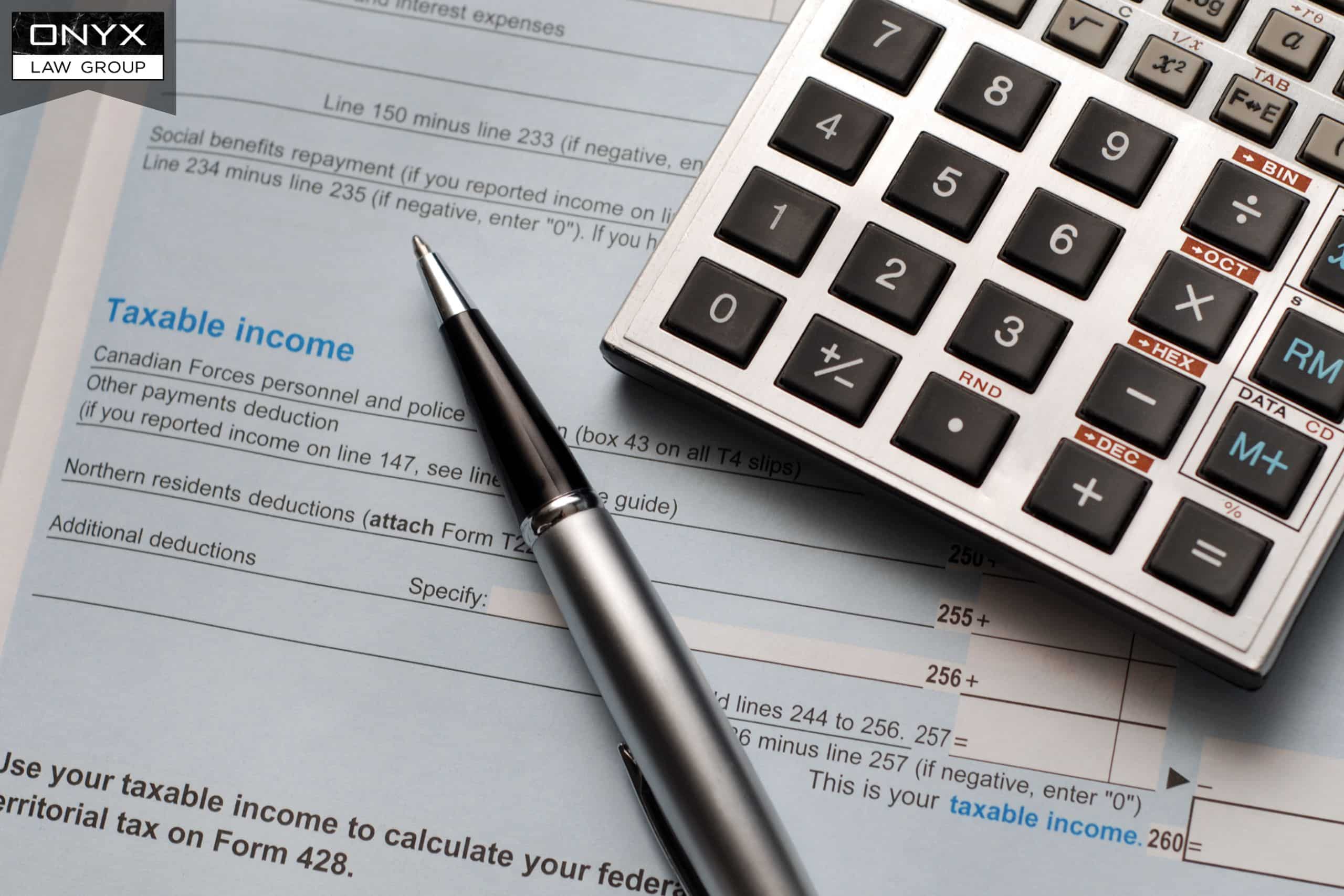
There can be significant tax implications that must be taken into account when negotiating a divorce settlement. For example, money received when you cash in an RRSP or profit realized from the sale of property that isn’t your family’s primary residence will have tax consequences. The CRA deems amounts received as taxable income; that must be factored in when determining what division of family property is fair.
You should also be aware that while child support is not taxable income in the hands of the recipient or tax deductible by the paying parent, spousal support is treated differently. Generally speaking, spousal support is tax deductible for the “payor” (i.e., the person paying spousal support) and considered taxable income under the Income Tax Act of Canada in the hands of the recipient.
Get Trusted Advice From Our Team of BC Family Lawyers
The divorce process in BC can be overwhelming and extremely difficult to navigate without help from an experienced lawyer. One of our BC divorce lawyers can help you evaluate your options and make wise decisions, tailored to your needs, goals, and circumstances.
Wondering what you’re actually entitled to in a BC separation? Judith A. Janzen has practised family law here since 2000 and leads the family law practice at Onyx Law Group. She holds the Canadian Bar Association’s BC Branch President’s Medal and argued Zhang v. Chen, a 2023 case with up to $90 million in assets that landed one of the province’s highest interim support awards. Contact us today for a free consultation.
Frequently Asked Questions
Divorce raises money questions that go well beyond who gets the house, and BC couples usually have a specific worry driving their search. Here are the ones we hear most.
Is My Inheritance Protected in a Divorce?
In BC, inheritances are generally treated as excluded property, meaning you keep the original value if you can trace it. Only the growth in value during the relationship gets divided, so keeping records of what you received and when matters a lot.
Am I Entitled to Spousal Support if I Make More Money Than My Spouse?
Yes, entitlement isn’t about who earns more but about need, length of relationship, and roles during the marriage. A higher-earning spouse can still owe support if the other gave up career opportunities for the household or children.
Does Moving Out of the House Affect What I’m Entitled To?
No, moving out doesn’t forfeit your share of family property or your parenting rights in BC. It can affect the practical dynamics of a custody case, so it’s worth planning that move with legal advice first.
How Is a Pension Split in a BC Divorce?
Pensions earned during the relationship count as family property and get divided, usually through a formal valuation and a division order sent to the plan administrator. The process differs for workplace pensions versus CPP, so getting the right paperwork matters.
What Happens if My Spouse Hides Assets During a Divorce?
Courts in BC take asset concealment seriously and can order full financial disclosure, impute additional income or property, or penalize the hiding spouse in the final division. If you suspect such conduct is happening, a lawyer can use disclosure tools and forensic tracing to uncover it.
Disclaimer: The information on this page is general legal information about British Columbia law, not legal advice for any specific situation. Reading this page does not create a solicitor-client relationship. BC law changes, and the procedure that applies to a specific situation depends on facts not covered here. For advice on your situation, consult a qualified British Columbia estate lawyer directly. Past results, illustrative scenarios, and reference to typical fact patterns do not guarantee similar outcomes in any specific case.