



In British Columbia, interim distribution allows some estate assets to be distributed to beneficiaries before an estate dispute, such as a wills variation claim, is fully resolved. However, distribution during ongoing litigation is subject to restrictions under the Wills, Estates and Succession Act (WESA), and the court may need to authorize the distribution. Understanding when interim distribution may be available can help beneficiaries protect their interests while waiting for a final decision on the estate.
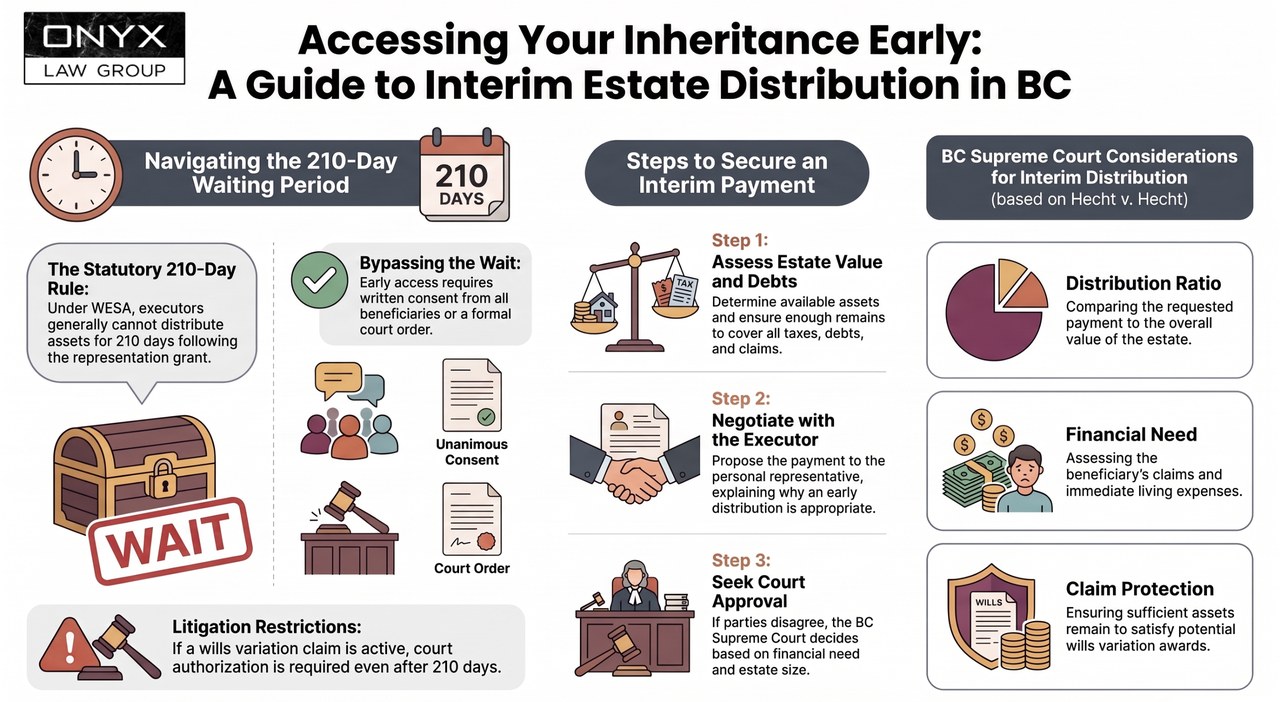
In BC, an executor generally can’t distribute the estate for 210 days. Getting money out sooner takes written consent from every beneficiary, or a court order. Veronica Manski runs our probate and estate administration team at Onyx Law Group, and the firm’s litigators take over when consent doesn’t come. If you need a share released early, contact us today for a free 30-minute consult.
In this blog, we will explain how interim estate distributions work in BC, when they may be allowed, and what beneficiaries should know before requesting an early payment.
What Is Interim Distribution?

Estate administration is increasingly relevant as British Columbia’s population ages. As of July 1, 2025, 20.5% of BC’s population was age 65 or older, according to Statistics Canada.
Interim distribution refers to the distribution of part of an estate to beneficiaries before the estate has been fully settled. In British Columbia, the personal representative generally cannot distribute an estate during the first 210 days after the representation grant unless the required consents are obtained or the court makes an order. Under the Wills, Estates and Succession Act (WESA), additional restrictions apply if there is a claim or proceeding that could affect how the estate should be distributed, including a wills variation claim.
An interim distribution can therefore allow beneficiaries to receive some estate assets while other matters remain unresolved, but it is not automatic. The personal representative must ensure that the distribution does not prejudice outstanding claims, and court approval may be required depending on the circumstances.
Most estates also require the personal representative to account for debts, taxes, and other expenses before distributing funds. In particular, if a wills variation proceeding has been commenced, the estate generally cannot be distributed without the court’s consent.
Can a Beneficiary Request an Interim Payment?
Yes. A beneficiary in British Columbia can ask the personal representative to make an interim payment from the estate, but receiving one is not automatic. Under section 155 of the Wills, Estates and Succession Act (WESA), an estate generally cannot be distributed within 210 days after the representation grant unless the required consents are obtained or the court orders the distribution. For an estate with a will, distribution within that period may be possible with the consent of all beneficiaries with an interest in the estate and all people who could bring a wills variation claim.
If the personal representative cannot make the payment without court approval, a beneficiary may need to seek an order from the court. The circumstances matter, including whether there are outstanding claims, debts, or potential wills variation proceedings that could affect the final distribution. Because an interim payment can affect the rights of other beneficiaries and claimants, legal advice can help determine whether requesting an interim distribution is appropriate in the circumstances.
How to Request an Interim Distribution of an Estate in BC

An interim distribution can give beneficiaries access to part of an estate before all estate matters are resolved. However, BC law places limits on when these payments can be made, particularly when a wills variation claim is involved. The following steps explain how to assess and request an interim distribution in British Columbia.
Step 1: Review the Estate and Your Potential Entitlement
Start by determining the value of the estate, the assets available for distribution, and any debts or liabilities that must be paid. If a wills variation claim is involved, consider how the claim could affect the amount ultimately available to each beneficiary. Under section 60 of the Wills, Estates and Succession Act (WESA), eligible spouses and children may ask the court to make adequate, just and equitable provision from the estate.
Step 2: Check Whether the Estate Can Be Distributed Without Court Approval
In BC, section 155 of WESA restricts distributions during the first 210 days after a representation grant unless the statutory consent requirements are met or the court makes an order. After 210 days, court consent is still required if a wills variation proceeding or another proceeding that could affect distribution has been commenced.
Step 3: Discuss the Proposed Payment With the Personal Representative
A beneficiary should raise the request with the executor, trustee, or other personal representative and explain why an interim payment is appropriate. The personal representative should consider the estate’s debts, other beneficiaries, potential claims, and whether enough assets will remain to satisfy any eventual court order, because making an improper distribution could leave the personal representative personally liable.
Step 4: Apply to the BC Supreme Court When Necessary
If the required parties are unable to provide the necessary consent, the personal representative may need to seek authorisation from the BC Supreme Court before making the distribution. The court may also consider whether a beneficiary is dependent on the estate for financial support when assessing the circumstances surrounding the proposed payment.
Step 5: Show Why the Distribution Is Appropriate
The court will look at the circumstances of the estate and the people affected by the proposed distribution. Factors can include the size of the proposed payment compared with the estate, the beneficiaries’ claims and financial needs, and whether sufficient assets will remain to address a potential wills variation award.
Step 6: Complete the Distribution Subject to Any Court Conditions
Executors should document interim distributions by obtaining signed receipts from beneficiaries where appropriate and keeping a clear record of the amount paid. The payment does not necessarily resolve the underlying wills variation claim, so the remaining estate may still need to be administered and distributed after the litigation is concluded.
When Will Interim Distribution Be Allowed?

If you are a beneficiary waiting for the outcome of a wills variation claim in British Columbia, you may have to wait for the estate to be fully resolved before receiving your inheritance. However, an interim distribution may be possible while the litigation is still ongoing. It allows some estate assets to be distributed before the court has finally decided how the estate should be divided.
If the beneficiaries or other parties whose interests could be affected do not consent, the executor or personal representative may need to apply to the court for permission to make an interim distribution. Under British Columbia’s Wills, Estates and Succession Act (WESA), the court has authority to permit a distribution in appropriate circumstances, including where there are outstanding claims that could affect the estate.
In Hecht v. Hecht Estate, the British Columbia Court of Appeal identified several factors relevant to deciding whether an interim distribution should be allowed while wills variation proceedings are pending. These include the amount proposed to be distributed compared with the overall value of the estate, the beneficiaries’ claims and financial needs, including living expenses, and whether sufficient assets will remain to address a potential wills variation award.
The court’s decision in Hecht shows that interim distribution is not guaranteed. Each estate is considered on its own facts, and the court must balance the beneficiary’s need for access to funds against the risk that an early distribution could prejudice the eventual outcome of the wills variation claim or other estate claims. The case provides a useful example of how BC courts approach these applications when determining whether an interim payment is appropriate.
High-Value Estate in Hecht v. Hecht

In Hecht v. Hecht Estate, John Hecht had built a substantial real estate business known as “The Equitable Group.” After his first wife died, John married Ursula in 1988. Before the marriage, they entered into an agreement limiting Ursula’s entitlement to his estate to $700,000, certain personal and household property, and the right to live in their home for three years after his death. John also established trusts that provided benefits to employees and other beneficiaries.
John died only 49 days after marrying Ursula, leaving an estate valued at approximately $32 million. Ursula later brought a wills variation claim, arguing that the estate was worth about $60 million and that she should receive approximately $12 million. The trial court ultimately dismissed her claim, finding that John had met his moral obligations to Ursula and that the provision made for her was adequate, just, and equitable. Ursula appealed the decision, leaving the estate’s distribution unresolved.
While the appeal was pending, the executors applied for permission to distribute certain trust funds from the estate. More than three years had passed since John’s death, and many of the trust beneficiaries had still not received their benefits. The executors argued that the distributions could be made without jeopardizing Ursula’s potential entitlement because enough assets would remain in the estate to satisfy any award that might result from the appeal.
The court considered the circumstances of the proposed beneficiaries. Many were elderly, including people in their 70s, 80s, and 90s, and some were seriously ill or had already died. The court also noted that the benefits under the Beta Trust were connected to the beneficiaries’ employment and service to John’s businesses, while the proposed distributions under the other trust reflected John’s intentions when he established it.
Justice Carrothers ultimately allowed the interim distribution. The court found that sufficient assets would remain to address Ursula’s potential claim, the beneficiaries had legitimate reasons for receiving the funds, and the sole residuary beneficiary consented to the distribution. The case demonstrates that BC courts may permit an interim distribution while a wills variation matter is still ongoing when the circumstances show that the payment is unlikely to prejudice the outstanding claim.
Early Inheritance vs. Waiting: Understanding Your Options
An interim distribution may allow beneficiaries to receive part of an inheritance before an estate is fully resolved. However, the best approach depends on the stage of the estate, whether a wills variation claim has been started, and whether the affected parties consent. Under section 155 of WESA, different requirements apply depending on these circumstances.
Approach | Main Advantage | Main Trade-Off | When It May Be Appropriate |
|---|---|---|---|
Wait for final distribution | Avoids the risk of distributing assets before outstanding estate claims are resolved. | Beneficiaries may have to wait considerably longer for their inheritance. | When there are significant disputes or uncertainty about the final distribution. |
Obtain the required consents | Can allow distribution without a contested court application. | Getting consent from everyone whose interests are affected may be difficult, particularly where a wills variation claim is possible. | When the relevant beneficiaries and potential claimants agree to the proposed distribution. |
Seek a court order for interim distribution | Gives the court an opportunity to authorize payment while protecting potential claims. | The application can involve additional legal costs, delay, and uncertainty. | When there is a legitimate need for funds but the required consents cannot be obtained. |
Make a limited distribution while reserving funds | Allows some beneficiaries to receive funds while preserving enough of the estate to address potential claims. | The amount that should be held back may be disputed and must be carefully assessed. | When the estate is large enough that the proposed payment is unlikely to interfere with a potential wills variation award. |
Bottom Line on Interim Disbursements in Wills Variation Actions

In British Columbia, the court can allow an interim distribution from an estate even when a wills variation claim under section 60 of the Wills, Estates and Succession Act (WESA) is still pending. The decision is discretionary and depends on the circumstances of the estate. The court will consider factors such as the beneficiaries’ claims and financial needs, the amount proposed to be distributed, the overall value of the estate, and whether the distribution could affect funds needed to satisfy a potential variation award.
An interim distribution is more likely to be permitted when there is a low risk that the payment will leave insufficient assets to satisfy a successful wills variation claim. In other words, a pending claim does not automatically prevent other beneficiaries from receiving their inheritance, but the court will take steps to protect the interests of anyone who may ultimately be entitled to a greater share of the estate.
How Can a Lawyer Help With Interim Distribution of an Estate in Canada
A lawyer can help determine whether an interim distribution of an estate is legally possible and advise you on the best way to proceed. In British Columbia, section 155 of the Wills, Estates and Succession Act (WESA) generally restricts estate distributions during the first 210 days after a representation grant, and court consent is required after that period if a wills variation proceeding or other proceeding affecting distribution has been started.
If the parties cannot agree to an interim payment, an estate lawyer can prepare and bring the appropriate court application. The lawyer can present evidence about the estate’s value, the proposed payment, the beneficiary’s needs, and the potential impact on other beneficiaries or a pending wills variation claim. BC courts have considered these factors when deciding whether to permit an interim distribution.
A lawyer can also help structure the distribution so that it does not unnecessarily prejudice other claims against the estate and help ensure the personal representative complies with their legal duties. This may include determining how much should remain in the estate to satisfy potential claims and ensuring that the personal representative follows WESA and any court order. Because the rules can differ depending on whether there is a will, a pending claim, or other estate litigation, obtaining advice early can help avoid an improper distribution and additional costs.
Need Help With the Interim Distribution of an Estate?
An interim distribution can allow beneficiaries to receive part of an estate before the estate is fully settled. However, BC law places restrictions on estate distributions, including the 210-day period under section 155 of WESA and additional requirements when a wills variation claim or other proceeding affecting distribution has been started.
Whether an interim distribution is appropriate depends on the circumstances, including the value of the estate, the amount being requested, the beneficiaries’ needs, and whether the payment could prejudice a potential claim. If you are considering an interim distribution or are involved in a disputed estate, speaking with a BC estate lawyer can help you understand your rights, assess the risks, and determine the appropriate next step.
Need access to your inheritance before the 210-day period is over? In BC, an executor generally cannot distribute estate assets during this period unless the required written consents are obtained or the court authorizes the distribution. At Onyx Law Group, Veronica Manski leads our probate and estate administration team, while our estate litigators can step in when beneficiaries cannot reach an agreement. Contact us today for a free 30-minute consultation to discuss whether an interim distribution may be possible in your situation.
Frequently Asked Questions
If you are waiting for an inheritance, you may have questions about partial distributions, when an estate can be distributed, and whether a beneficiary can receive funds before the estate is fully settled. These FAQs explain how interim payments and distributions may work during the estate administration process in BC.
How Long Does Interim Distribution Take?
There is no fixed timeframe, so the answer depends on the estate’s circumstances, the stage of administration, and the personal representative’s discretion. In BC, the personal representative generally cannot distribute the estate during the first 210 days after the representation grant unless the required consent is obtained or the court authorises the distribution.
Can a Deed of Variation Be Done After Distribution?
A private agreement may sometimes change how beneficiaries receive their interests, but a distribution that has already occurred can create complex issues for the deceased estate. The personal representative and beneficiaries should seek legal consultation before acting, particularly where interested parties may challenge the distribution or there is a risk of a shortfall.
What Does Interim Distribution Mean in a Will?
An interim distribution is a partial distribution made before the estate is fully settled. The personal representative is responsible for retaining holdbacks for legal and administrative expenses, along with sufficient funds to cover the estate’s liabilities, income taxes, accounting, and other expenses, rather than distributing funds that may later be needed. Where appropriate, the personal representative may also obtain a Clearance Certificate, which confirms that the estate’s tax obligations have been addressed before making a final distribution.
Can a Beneficiary Get an Interim Payment?
Yes, a beneficiary may receive an interim payment in certain circumstances, subject to the personal representative’s legal authority and the requirements of WESA. Before making a payment, the personal representative should consider the likelihood of claims, whether other interested parties have received proper notice, and whether sufficient funds remain to meet the estate’s obligations.
Disclaimer: The information on this page is general legal information about British Columbia law, not legal advice for any specific situation. Reading this page does not create a solicitor-client relationship. BC law changes, and the procedure that applies to a specific situation depends on facts not covered here. For advice on your situation, consult a qualified British Columbia estate lawyer directly. Past results, illustrative scenarios, and reference to typical fact patterns do not guarantee similar outcomes in any specific case.