



In British Columbia, the answer is almost always no. An executor must distribute the estate exactly as the will directs and follow their legal duties under the Wills, Estates and Succession Act (WESA), so personal preference has no say in who inherits.
If you have been given the important role of acting as executor for the estate of a deceased, and you are unsure what decisions you can and cannot make with respect to estate assets, it is important to speak with someone who can provide legal advice tailored to your circumstances. Onyx Law Group has run an estate litigation practice out of downtown Vancouver since 2012, and disputes over executors who overstep are a core part of that work. Veronica Manski heads the firm’s probate and estate administration practice and works exclusively in estates and trusts. If an executor is making calls that are not theirs to make, contact us today for a free initial consultation.
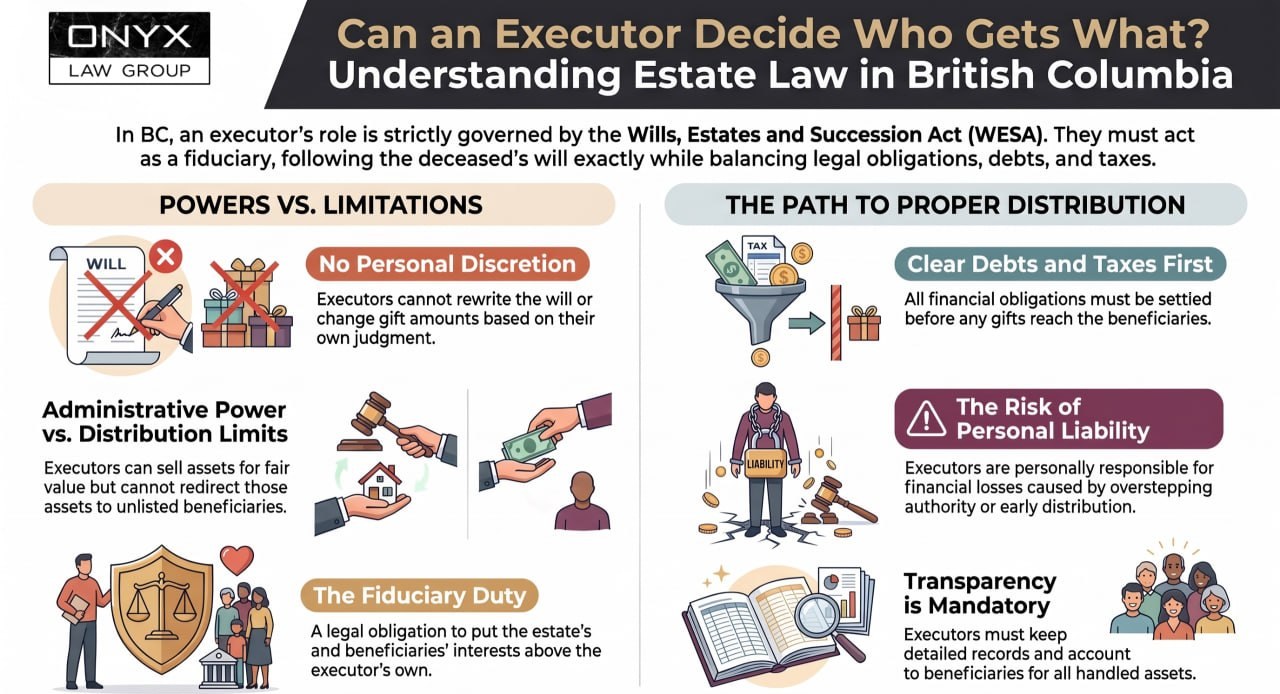
In this blog, we will explain what authority an executor actually has in deciding who receives what from an estate and clarify the legal limits on an executor’s decision-making authority.
Can an Executor Decide Who Gets What in the Estate?
An executor, sometimes called a personal representative, is the person named in a will to manage the deceased person’s estate. It’s a role that carries real weight, and it’s rarely as simple as people expect.
Every year, tens of thousands of British Columbians pass away, and each death can open a probate process with its executor, its own beneficiaries, and its own potential for conflict. Statistics Canada recorded roughly 43,900 deaths in BC in 2024 alone, so the scenario isn’t a rare situation. It’s a situation that families across the province deal with constantly.
In British Columbia, an executor’s authority comes from the will itself and from provincial law, primarily the Wills, Estates and Succession Act, along with other succession laws that shape how estates are handled. That means an executor doesn’t have free rein over the estate’s assets. They’re bound to carry out the will as written, and stepping outside that role can expose them to personal liability.
That said, executors generally do make plenty of decisions along the way. Once appointed through the probate process, their duties typically include locating and securing estate property, obtaining a grant of probate, and taking control of accounts and assets. From there, they preserve the estate according to the will’s terms, pay outstanding debts and bills, and file any tax returns owed on the deceased’s behalf.
Sometimes fulfilling those duties means selling assets, whether to cover debts or to make distribution possible, including personal property that isn’t specifically gifted in the will. Executors are also allowed to bring in outside help. Financial advisors, lawyers, and accountants often play a role in untangling more complicated estates, and leaning on them isn’t a shortcut. It’s often exactly what the job requires.
Eventually, the executor distributes what remains to the beneficiaries, following both the will and BC law. Throughout the process, they’re expected to keep clear records and account to family members and other interested parties for how they’ve handled the estate. None of these steps is optional. These are fiduciary duties, and BC courts take them seriously.
At the core, a fiduciary duty means acting in someone else’s best interest, not your own. For an executor, that means putting the estate and its beneficiaries first every time. Self-dealing, conflicts of interest, and cutting corners aren’t just frowned upon. Courts have removed executors for exactly this kind of conduct, and beneficiaries have real legal grounds to challenge an executor who strays from these duties.
What Are the Executor’s Powers and Limitations?

An executor’s authority is broad but never absolute. The Wills, Estates and Succession Act (WESA) and common law give executors power to pay debts, manage estate property, and even incur reasonable expenses on the estate’s behalf.
Depending on what the will says, an appointed executor might also manage property held in trust for a minor beneficiary, or decide the right time to sell real estate so it fetches fair market value. The will itself usually spells out these powers, so executors need to read it closely before acting, since good estate planning often anticipates exactly these kinds of decisions. Stepping outside those terms can mean personal liability for any loss the estate suffers as a result.
Beyond exercising powers, executors carry a full set of duties. They have to locate and value every asset, pay off debts and taxes, and then distribute what’s left to the beneficiaries named in the will. These executor duties sit squarely within BC probate and estate administration law, and the process can get complicated fast. Working with a probate lawyer helps executors stay on the right side of both the will’s instructions and their legal obligations.
Executors also face firm limits on what they can do. Their authority is limited in the truest sense: they cannot rewrite who inherits what, change gift amounts, or otherwise alter the will’s terms. If a family trust is involved, they have to follow its terms exactly and can’t redirect trust assets elsewhere. Executors are also barred from paying out to beneficiaries before the estate’s bills and taxes are settled, using estate property for their own benefit, misleading the court, or keeping beneficiaries in the dark about the estate.
These boundaries exist because executors hold a fiduciary duty. That means acting with honesty, fairness, and integrity at every step, always in service of the deceased’s actual wishes, including meeting every financial obligation tied to the estate before anything else. Breaching that duty can bring real consequences, from disputes with beneficiaries to personal liability or full-blown probate litigation. Staying transparent and sticking closely to the will is really what keeps an executor out of trouble.
What Are the Factors That Influence the Executor’s Decisions?
Even though a will outlines the wishes of the deceased, executors still make important day-to-day decisions when managing an estate. Their choices are guided by several factors, starting with the will itself, which serves as the primary roadmap for asset distribution. Executors must carefully follow these instructions while balancing other responsibilities.
Legal obligations also shape an executor’s decisions. Each province has specific estate laws that govern its administration. For example, in British Columbia, the Wills, Estates and Succession Act, the Probate Administration Act, and the Trustee Act set out clear duties and limits.
Executors may also need to consider potential disputes, using their discretion to make decisions that minimize conflicts among beneficiaries and prevent delays in probate, since getting this wrong can mean being held personally liable for the resulting loss.
The type of asset and principles of fairness further influence decisions. Real estate, for instance, might be held to wait for market gains or sold quickly to maximize value. Executors must act transparently, keeping beneficiaries informed and maintaining detailed records for the court. Beneficiaries have the right to challenge decisions they see as unfair, including how trust assets are managed, which can lead to mediation or court intervention if disputes arise.
Can an Executor Override a Will?
Executors don’t have the power to override or rewrite a will. Their job is to carry out its terms as written, nothing more. There are only a few situations where the terms don’t apply as written. A court might declare the will invalid, which means its terms no longer govern how the estate is managed. All beneficiaries might agree in writing to change how the estate is distributed, or the estate might be insolvent, meaning its debts must be paid before any gifts go out.
These are narrow exceptions, and they don’t give an executor the freedom to make their own decisions about what seems fair. Each one has specific legal requirements behind it, and stepping outside those requirements while an executor manages the estate puts them on shaky ground.
Trying to override a will outside these situations is a serious breach of fiduciary duty. Beneficiaries can take legal action, and courts can remove an executor from office for acting inappropriately in this way. If there’s any chance an action might cross that line, the smart move is talking to a lawyer or probate attorney first. That conversation is a lot cheaper than the fallout from getting it wrong.
What an Executor Can Decide vs What They Cannot
Executors carry a lot of responsibility, but not all of it comes with real choice. Some decisions sit entirely with the executor, others are locked in by the will or by BC law, and getting the two confused is where most disputes start. The table below lays out where that line actually falls.
Decision | Can the Executor Decide? | Where the Authority Comes From | If They Overstep |
|---|---|---|---|
Who inherits | No | The will itself. If there’s no will, intestacy rules under WESA decide | Breach of fiduciary duty, possible removal, personal liability |
How much each beneficiary gets | No | Fixed by the will’s terms or the intestacy formula | Beneficiaries can sue to recover misdistributed funds. |
Timing of final distribution | Limited | WESA sets a 210-day waiting period after probate is granted, tied to the 180-day window for wills variation claims | Personal liability if assets are distributed early and a claim is later filed |
Selling estate property | Often yes | Usually granted by the will, or required to pay debts and settle the estate | Liable for losses if sold below fair value or without proper authority |
Dividing personal items among beneficiaries | Sometimes yes | Only if the will explicitly gives the executor that discretion | Can be challenged as favouritism if no such discretion exists |
Paying debts before gifts go out | Yes, and it’s required | Executor’s legal duty under WESA and the Trustee Act | Personal liability for unpaid debts or improperly distributed funds |
Hiring a lawyer, accountant, or advisor | Yes | General authority to administer the estate properly | Not typically a source of liability, since fees come from the estate |
Interpreting an unclear clause in the will | Not unilaterally | Requires an application to the BC Supreme Court for directions | Acting on a wrong interpretation can itself be a breach of duty |
Changing or amending the will | No, never | Only the testator can do this, and only while alive | Any attempt is void and likely fraudulent |
How Executors Should Approach Estate Distribution in BC

Following the right process protects both the executor and the beneficiaries. Here’s how an executor moves from appointment to final distribution while staying within BC law.
Step 1: Review the Will Thoroughly
Before making any moves, an executor needs to read the will carefully and understand exactly what it says. This means identifying who the beneficiaries are, what each person is entitled to, and any specific instructions the testator left behind.
Step 2: Apply for a Grant of Probate
In most cases, an executor needs court approval before they can legally act on the estate’s behalf. Applying for probate through the BC Supreme Court confirms the will is valid and gives the executor the legal authority to manage and distribute assets.
Step 3: Identify and Secure All Assets
Once authority is confirmed, the executor locates, values, and protects everything the deceased owned. This includes real estate, bank accounts, investments, and personal property, and it often means changing locks, notifying financial institutions, or arranging insurance.
Step 4: Notify Beneficiaries and Creditors
Executors are required to let beneficiaries know about their role in the estate and to notify any known creditors. This step keeps the process transparent and gives creditors a chance to make claims before assets go out the door.
Step 5: Pay Debts, Taxes, and Expenses
Before a single dollar reaches a beneficiary, the executor has to settle outstanding debts, file the deceased’s final tax return, and cover administration costs. Skipping this step or paying beneficiaries first can create personal liability for the executor.
Step 6: Distribute the Estate According to the Will
Once debts and taxes are cleared, the executor distributes what remains exactly as the will directs. There’s no room for personal judgment here. The will decides who gets what, not the executor’s own sense of fairness.
Step 7: Keep Detailed Records Throughout
Every decision, payment, and communication should be documented as the process unfolds. Good records protect the executor if a beneficiary ever questions how the estate was handled, and they make the final accounting far easier to prepare.
Legal Framework and Executor Discretion
Executors have real legal boundaries to work within, not just a general sense of good intentions. Probate law and the fiduciary duties that come from common law shape everything they do. This isn’t just paperwork and admin.
It’s a legal obligation to manage the estate responsibly and ethically. That means acting in good faith at every step, staying away from self-dealing, respecting what the will actually says, and keeping full financial transparency with beneficiaries. These duties exist so the estate is handled fairly and beneficiaries’ rights stay protected the whole way through probate, and they also help the executor of an estate steer clear of potential conflicts with the people they’re accountable to.
When an executor ignores these obligations, the consequences are real. Beneficiaries can sue for breach of fiduciary duty, and a court can order the executor to repay any funds that were misused. In some cases, the executor also loses their right to compensation for the work they did. Without expert guidance early on, small missteps can snowball into severe consequences, and the role comes with weight that cutting corners will only add to.
Dispute Resolution Among Beneficiaries
Unfortunately, beneficiaries often dispute estate administration, even when the estate has been carefully planned. Executors are essential in handling these disputes with professionalism and fairness, guaranteeing that no beneficiary receives preferential treatment. They must remain neutral and cannot show favoritism, distribute property unequally unless dictated by the will, or act without transparency.
Executors must also avoid disputes over the will’s meaning, as their job is to manage the estate fairly and as stated. Their primary responsibility is to manage the estate efficiently while maintaining fairness among all beneficiaries. Any perceived bias or partiality can create legal challenges and undermine trust in the administration process.
When disputes over a will’s terms or beneficiaries arise, they can be resolved either through court proceedings or mediation. Mediation often offers the advantage of preserving family relationships and avoiding the high costs of litigation, though court intervention is sometimes necessary. Throughout the process, executors should keep detailed records of their actions and consistently uphold neutrality to protect both the estate and themselves from potential claims.
How Does Probate Affect Asset Distribution?
Going through probate doesn’t usually change what property counts as part of the estate or who gets what. That part is fixed by the will itself. What probate does change is how the estate gets administered along the way. It’s a court-supervised process, and understanding what it actually involves helps explain why it matters even though it doesn’t touch the distribution itself.
Probate validates the will and confirms the executor has legal authority to manage everything. During this process, the executor files the will and obtains the probate grant, notifies beneficiaries and potential creditors, then collects, inventories, and values every estate asset. From there, the executor pays debts, taxes, and administration costs out of estate funds and only distributes assets once the court has given approval.
Following this process matters for more than just formality. It protects the executor from personal liability, since actions taken according to court-approved procedures are shielded in a way that shortcuts wouldn’t be.
Even with the process clearly laid out, executors face real obstacles along the way. Delays are common, caused by everything from incomplete paperwork to allegations of mismanagement.
Disputes can also crop up even without any conflict between beneficiaries, for instance, when asset ownership is unclear because records are missing. And if litigation gets involved, legal costs can climb fast, though the estate typically covers those costs rather than the executor personally.
None of this means challenges are inevitable. Bringing in an experienced probate lawyer early on tends to head off unnecessary delays before they grow, or resolve problems with far less stress and cost if they do come up.
Thinking through your estate planning needs ahead of time can also save your executor a lot of hassle later on. Staying open and transparent with beneficiaries throughout the process is also important. And keeping accurate accounting records means that if questions ever come up about how the estate was managed, there’s a clear answer ready.
Are There Consequences for Mismanaging an Estate?
Executors who mismanage estate funds or act dishonestly can end up facing real consequences. That includes personal liability for any financial losses caused and, in serious cases, removal as executor altogether. Beneficiaries aren’t powerless here either. They can demand transparency at any point, and if misconduct causes them harm, they are entitled to sue for damages.
The good news is that most of these issues are preventable. Executors who get professional advice early on have a much clearer picture of their fiduciary obligations from the start.
Keeping detailed records, communicating with beneficiaries throughout the process rather than just at the end, and checking in with a lawyer before any major decision all go a long way. These habits don’t just keep an executor on the right side of the law. They also tend to keep families from turning against each other during an already difficult time.
Take Control of Your Inheritance Today
Many people wonder whether an executor has the authority to decide how an estate’s assets are distributed. In reality, an executor’s role is to carry out the instructions outlined in the will and to manage the estate according to the law. Executors must act fairly and impartially, avoid showing favoritism, and cannot distribute assets differently from what the will specifies. They are responsible for ensuring that all beneficiaries receive their rightful shares and that the estate is administered transparently and legally.
Disputes or confusion about asset distribution can arise, especially if a will is unclear or contested. In such situations, it is crucial to consult an experienced estate or probate attorney who can provide guidance, help interpret the will, and ensure that the executor fulfills their duties correctly. Seeking professional advice from an experienced estate lawyer not only shields the executor from potential legal claims but also fosters family relationships and ensures a smooth administration of the estate.
Are you unsure whether an executor can decide who gets what in an estate? At Onyx Law Group, our experienced probate lawyers guide families through the complexities of estate administration, ensuring every decision aligns with the law and the will. We provide clear, practical advice to prevent disputes and protect both the executor and beneficiaries. Contact us today to navigate estate matters with confidence and peace of mind.
Frequently Asked Questions
Many people wonder about the powers of an executor when distributing an estate. This FAQ section answers common questions about whether an executor can decide who gets what and clarifies their legal responsibilities.
Can an Executor Decide Who Gets What? If Not, What Determines the Distribution?
Executors are to be guided by the will, estate laws in their jurisdiction, and fiduciary obligations. They cannot personally choose beneficiaries unless the will grants this specific discretion.
Can an Executor Override a Will and Distribute Assets Differently?
No. Executors must follow the terms of the will. Altering these terms without legal authority may lead to executor liability or removal by the probate court.
What Are the Duties of an Executor?
Executors handle estate administration. They locate property, pay debts, file taxes, and distribute property to the beneficiaries according to the will. They must act in the estate’s and beneficiaries’ best interests and follow the probate process.
Can an Executor Change a Will?
No. Only the testator (the person who made the will) can amend it while alive, either through a codicil (a document attached to the will) or by making a new will. Executors are duty-bound to implement the testator’s wishes.
Disclaimer: The information on this page is general legal information about British Columbia law, not legal advice for any specific situation. Reading this page does not create a solicitor-client relationship. BC law changes, and the procedure that applies to a specific situation depends on facts not covered here. For advice on your situation, consult a qualified British Columbia estate lawyer directly. Past results, illustrative scenarios, and reference to typical fact patterns do not guarantee similar outcomes in any specific case.