



Estate administration after a death typically involves four key steps: filing the will with probate court, notifying creditors and beneficiaries, paying debts and taxes, and distributing remaining assets. The process is often complex and emotionally difficult to manage alone. With the right guidance, executors, administrators, and family members can navigate probate smoothly and carry out their loved one’s final wishes.
At Onyx Law Group, we’ve been walking Vancouver families through probate since 2012, and Veronica Manski, who heads our probate and estate administration practice, has spent her entire career in estates and trusts since joining the BC bar in 2015. We prepare and file your Supreme Court probate application, handle the WESA notices that need to go out before anything’s submitted, and sort things out with the registry if your package comes back flagged. Because our lawyers also litigate wills variation and executor conduct disputes, we know which filing decisions tend to come back to haunt executors later, so we can help you avoid them from the start. If you’ve just been named executor and want a second set of eyes on your checklist, contact us today for a free consultation.
This blog walks executors and administrators through the essential steps of the probate process in British Columbia, from filing the will to distributing the estate’s final assets.
What Is Probate in BC?
Every year, tens of thousands of British Columbians pass away. 45,102 people died in the province between mid-2022 and mid-2023 alone, leaving families to navigate the estate administration process, often for the first time.
Probate is a legal process that starts with preparing and filing a probate application in the BC Supreme Court to validate a deceased person’s will. Through this process, the Supreme Court formally approves the original will as the valid last will and testament of the deceased person and issues an estate grant (called a grant of probate).
The Grant of Probate issued by the court confirms the legal authority of the person named in the will to act on behalf of the deceased’s estate. That person, known as the “executor,” is then legally authorized to deal with estate assets, pay estate debts, and distribute what is left of the estate to beneficiaries named in the will.
If the person died without a will, the spouse, a family member of the deceased, or another person can apply to be appointed the “administrator” of the estate. If successful, the Court will issue an estate grant called a grant of administration. Both types of estate grants (the Grant of Probate and Grant of Administration) have the same legal effect and vest the applicant with the same legal powers to act on behalf of the deceased’s estate.
Note that when a person dies without a will, they are said to have “died intestate.” In that situation, estate assets must be distributed to the deceased’s heirs in accordance with the rules of intestacy in BC.
Probate BC Checklist: How to Manage the Application Procedure
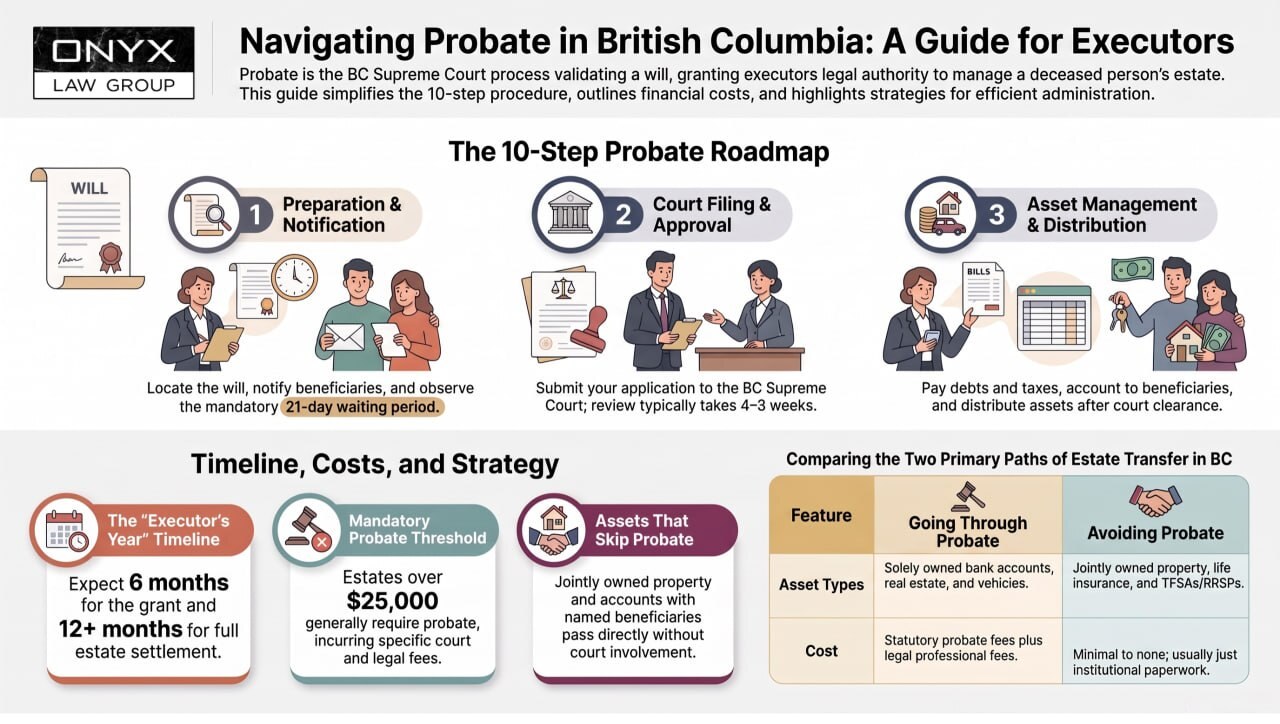
We’ve just discussed what probate is, and now we will provide you with a checklist of the steps in a typical probate application in BC. Following these steps in order can help executors and administrators avoid common delays and stay on track throughout the process.
Step 1: Locate the Will and Confirm the Executor(s)
The first task is to locate the originally signed version of the deceased person’s will and review it to confirm the person or people named as executor. The executor(s) have a lot of responsibilities, starting with making funeral arrangements, paying funeral expenses, and notifying beneficiaries and other interested parties of the deceased’s passing.
Step 2: Seek Legal Advice
It’s strongly recommended that the executor hire an experienced probate lawyer, even if the estate seems “simple.” The probate lawyer can conduct a formal search of the Wills Registry to determine whether any will or a more recent will of the deceased has been registered, advise on whether an estate grant is necessary, and help put the probate forms and paperwork together.
Step 3: Gather Documents and Information
The executor must gather contact information for beneficiaries named in the will, close family members of the deceased, and intestate successors (those who would inherit if there was no will); compile a detailed inventory of the deceased’s assets and liabilities; and obtain essential documents (e.g., death certificate from the funeral home, property deeds, etc.).
Step 4: Notify Beneficiaries and Interested Parties
It is the executor’s responsibility to provide formal notice to certain people before filing the estate grant application. Using the proper form, the executor must notify the named beneficiaries and other interested parties (intestate successors, creditors, immediate family members such as the deceased’s spouse, even if they aren’t named in the will, etc.).
There is a 21-day waiting period that must be observed after the notices are delivered, which means the estate grant application cannot be submitted until at least 21 days after the notices have been sent.
Step 5: Prepare the Probate Application
There are several forms and affidavits that must be sworn by the applicant and filed with the Supreme Court. It’s a good idea to start preparing the probate forms and affidavits during the 21-day waiting period so they are ready to be filed once that notice period has passed.
Necessary probate forms include the Submission for estate grant (Form P2), an Affidavit of assets and liabilities for domiciled estate grant (Form P10) listing all of the deceased’s assets and liabilities, and an Affidavit of delivery (Form P9) confirming that all necessary parties received notice in accordance with Step 4. The original will is also filed with the probate application.
Step 6: File the Probate Application
The executor can file the application materials in person or electronically. Court filing fees and probate fees (if payable) are due when the probate application is filed.
The Supreme Court reviews probate applications in the order in which they were filed. It takes 4-8 weeks for the court to process a typical probate application, but it will take longer if there are mistakes in the application, missing documents, or if other issues arise. Once the application has been approved, the court issues the estate grant.
Step 7: Manage Estate Assets

After the estate grant has been issued, the executor will get certified copies of the estate grant, which he or she can then provide to third parties as proof of their authority to deal with the deceased’s assets. The executor can liquidate the deceased’s assets and/or transfer ownership of the deceased’s assets into the name of the estate.
The money is pooled together after estate assets have been sold or liquidated and the funds are held in trust. The executor can make an interim distribution from the funds held in trust to the estate beneficiaries but may not distribute all of what remains in the estate until debts, liabilities, and income taxes have been paid.
Step 8: Pay Debts and Taxes
The executor is responsible for locating and notifying any creditors of the estate and for settling debts and liabilities of the estate (e.g., mortgage on the deceased’s home, credit cards, household bills, lines of credit, and loans). The executor must also prepare income tax filings on behalf of the deceased and their estate and ensure all taxes are paid.
Step 9: Account to Beneficiaries
The executor must prepare a detailed accounting of receipts and disbursements incurred during administration of the estate, an accounting of the executor’s fees, and a proposal as to the distribution of the estate. The executor must obtain approval from beneficiaries (by consent) or approval from the court (by way of a passing of accounts hearing).
Step 10: Distribute Remaining Assets
After accounting to the beneficiaries and receiving the clearance certificate from the Canada Revenue Agency, the executor can distribute the remainder of the estate’s assets to the beneficiaries according to the will.
When Is It Mandatory to Begin the Probate Process?

A probate application is mandatory when the person died without a will owning certain types of assets. An administrator has to be appointed by the court to act on behalf of the estate and deal with that property (e.g., assets solely held by the deceased, such as a house or cottage).
If, however, the deceased person left a will, probate may not be mandatory. Instead, the question of whether probate is needed depends on factors such as the value of the estate, the type of assets the deceased person owned, how they owned those assets, and whether any legal disputes arise (wills variation claims, challenges to the will’s validity, etc.).
Probate is likely to become even more common in the years ahead. According to BC Stats population projections, the share of British Columbians aged 65 and older is expected to keep rising, while the working-age population is projected to hold steady at around 63%, meaning more estates and more executors in the coming years.
What Are the Estate Planning Strategies That Can Help Avoid Probate?
The deceased person may have done estate planning during their lifetime to avoid probate. For example, if the deceased’s only assets at death are a bank account and a home jointly owned with their spouse, both of those assets pass to the surviving spouse by operation of the right of survivorship, without the need for probate. Similarly, assets that include named beneficiaries apart from the estate, such as life insurance, TFSAs, and RRSPs, pass outside of the estate and don’t require probate.
When Is It Necessary to Probate a Will?
In most cases, an executor finds out that a probate application is necessary when they try to deal with certain types of property, such as the deceased person’s bank accounts, real estate, investments, or vehicles. Third parties such as a financial institution, the Land Title Office, ICBC, and the Canada Revenue Agency have strict rules in place to ensure that a deceased person’s property is not transferred contrary to the law.
A court-certified copy of the Grant of Probate is recognized by third parties and tells those third parties that the executor has legal authority to act on behalf of the estate (to sell or transfer real property, transfer money and close bank accounts, etc.).
Is There a Probate Exemption for Small Estates?
There is an exemption in BC for smaller estates. If the value of the estate does not exceed $25,000, a probate application may not be required, but it depends on the type of assets the deceased person owned when they died. For example, if the deceased person owned a vehicle, bank account, or certain types of investments, a small estate may still need a probate application.
Note that if the value of estate assets does not exceed $25,000 and probate is needed, the Grant of Probate is issued without the estate having to pay probate fees or court fees.
Probate vs. Avoiding Probate: Which Applies to You?
Not every asset needs to go through probate. The table below compares the two paths so you can see where your situation fits.
| Going Through Probate | Avoiding Probate | |
|---|---|---|
| How it works | The executor applies to the BC Supreme Court for a grant of probate or administration. | Assets pass automatically via joint ownership (right of survivorship) or named beneficiaries. |
| Typical assets | Solely owned bank accounts, real estate, investments, vehicles | Jointly owned property, life insurance, TFSAs, RRSPs with named beneficiaries |
| Timeline | ~6 months for the grant, up to a year+ for full administration | Often days to weeks, no court application needed |
| Cost | Probate fees ($6–$14 per $1,000 over $25,000) plus legal fees | Minimal to none, usually just paperwork with the institution |
| Court involvement | Required | None |
| Best suited for | Estates with solely owned property, no prior planning, or disputes | Estates where planning was done in advance (joint accounts, beneficiary designations) |
How Long Does Probate Take in BC?
Probate in BC typically takes about six months to obtain the estate grant, though timelines vary. Delays often arise from the estate’s complexity, the executor’s experience and availability, court processing times, and unusual issues such as a will that doesn’t meet formal requirements, a beneficiary who can’t be located, or complications with the public guardian and trustee. Errors or missing documents in the probate application are another common source of delay.
Once the grant is issued, fully administering the estate and distributing inheritances often takes another year or more. There’s no hard legal deadline, but BC follows the “executor’s year” convention, a general expectation that executors and administrators will gather assets and settle the estate’s affairs within twelve months. That clock starts from the date of death or from the date the grant is issued if probate was required.
BC also has a 210-day rule where executors must generally wait 210 days after the grant is issued before distributing assets to allow time for will variation claims and creditor claims.
What Are the Common Challenges in the Probate Process?
Not every probate case moves smoothly. Disputes sometimes arise over whether a will is valid, leading to a formal challenge to the will. Separately, a spouse or child may bring a wills variation claim, arguing the will doesn’t provide for them fairly. Locating all beneficiaries can also slow things down and, in some cases, lead to unclaimed inheritances that go unresolved for months or longer.
Estates with assets in another jurisdiction add another layer of complexity, often requiring additional legal steps to properly administer property outside BC. Debt issues can complicate matters too because an executor may need to take legal action to recover money owed to the estate or may need to contest or defend against claims relating to the estate’s liabilities.
Personal dynamics can be just as disruptive as legal ones. Conflict between beneficiaries and executors is common, often stemming from poor communication, delays in administration, or concerns about how estate assets are being managed.
When any of these challenges arise, they can significantly extend the probate timeline and add complexity to what is already a difficult process. Executors and administrators facing these situations often benefit from professional legal guidance to help resolve disputes and keep the estate administration moving forward.
When to Seek Legal Assistance?

You should seek legal assistance as soon as possible if any of the challenges just discussed arise. A probate and estate litigation lawyer can explain rights, options, and legal processes for handling any disputes or issues that come up.
That being said, you don’t need to wait for a problem to seek legal assistance. A skilled lawyer can advise whether probate is necessary, and if so, assist with completing the application as efficiently as possible, ensuring that deadlines aren’t missed and mistakes are avoided in the probate process. Whether you are an executor, administrator, trustee, or beneficiary, if you have questions, concerns, or suspicions surrounding a loved one’s estate, you should speak to a lawyer.
For example, one client came to Onyx Law Group after being named executor of her father’s estate, overwhelmed by a probate application that had already been rejected once due to missing documentation and an unclear asset inventory. She was also facing pushback from a sibling questioning how estate funds were being handled.
Our probate lawyers stepped in to reorganize the application, correctly identify and value all estate assets, and communicate clearly with the beneficiary to defuse the dispute before it escalated into formal litigation. With the corrected application, the court issued the Grant of Probate within weeks, and the client was able to distribute the estate to her family without further conflict or delay.
Need a Probate Lawyer in British Columbia?
Probate in BC follows a few key steps: find the will, get legal advice, gather documents, notify beneficiaries, then file the application and wait. Once granted, the executor pays off debts and accounts to beneficiaries and distributes what’s left. Not every estate needs probate; jointly held assets and those with named beneficiaries often skip it, but solely owned property or accounts almost always require it.
Even straightforward estates can hit snags: missing documents, hard-to-locate beneficiaries, disputes over the will, or conflict between beneficiaries and executors. These issues can add months to the process and put executors at personal risk if handled incorrectly. That’s why it’s worth talking to an estates lawyer early, not just when something goes wrong.
Named executor and not sure where to start? The team of BC probate lawyers at Onyx Law Group has been guiding BC families through probate since 2012. Veronica Manski leads our estates and trusts practice, and our lawyers handle the disputes too, so we know which mistakes turn into litigation. Contact us today for a free consultation and get it right the first time.
Frequently Asked Questions
Have questions about the probate process in BC? Below are some of the most common questions executors, administrators, and beneficiaries ask when navigating probate for the first time. If you don’t see your question here, our estate lawyers are happy to help.
How Much Does Probate Cost in BC?
There’s no fee for estates under $25,000, then it’s $6 per $1,000 on value between $25,000 and $50,000, and $14 per $1,000 above that, plus a $200 government court filing fee. Lawyer fees are separate and typically run $3,000–$7,000+ depending on complexity, so factor that payment into your estate budget.
Do I Need a Lawyer to Apply for Probate in BC?
You’re not legally required to hire one, but it’s strongly recommended given how many written forms and affidavits must be submitted correctly to the court. A lawyer helps ensure your proposed application has the right evidence attached and avoids the delays that come with mistakes.
What Happens if There’s No Will?
When someone dies without a will, BC’s intestacy rules determine who inherits, typically starting with a spouse and children. An administrator must still apply for a Grant of Administration before they can access accounts, sell property, or deal with the deceased’s estate.
Can You Avoid Probate in BC?
Yes, in some cases. Assets held jointly with right of survivorship, or those with named beneficiaries like life insurance, RRSPs, and TFSAs, usually pass outside the estate, though items like a safety deposit box or accounts held solely with financial institutions almost always require probate to access.
Is There a Deadline for Executors to Distribute the Estate in BC?
There’s no strict legal deadline, but BC follows the “executor’s year” which is a general expectation that the estate will be settled and complete within twelve months of death or the grant being issued. Executors typically need a death certificate, the deceased’s social insurance number, and full documentation of assets before they can finalize accounts and release cash to beneficiaries.
Disclaimer: The information on this page is general legal information about British Columbia law, not legal advice for any specific situation. Reading this page does not create a solicitor-client relationship. BC law changes, and the procedure that applies to a specific situation depends on facts not covered here. For advice on your situation, consult a qualified British Columbia estate lawyer directly. Past results, illustrative scenarios, and reference to typical fact patterns do not guarantee similar outcomes in any specific case.